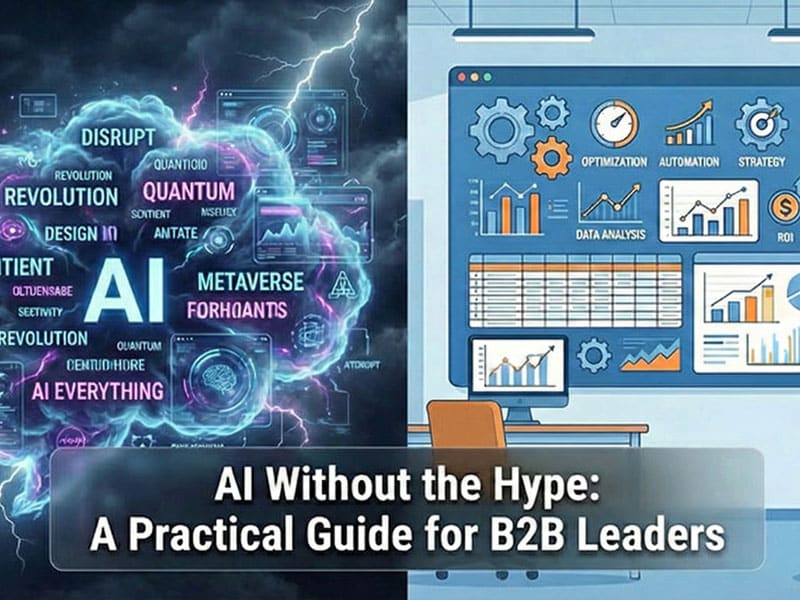
AI adoption is the process of integrating artificial intelligence into an organization’s daily operations so it produces measurable business outcomes. However, it fails most often not because the technology is wrong but because nobody changes how they work. In fact, more than 80% of AI projects fail to deliver expected results. The root cause is almost always the same: organizations buy tools without building the habits, governance and workflows required to use them.
This post breaks down why AI adoption stalls, what the most common mistakes look like and what organizations that actually scale AI do differently.
What is AI adoption and why does it matter now?
AI adoption goes far beyond purchasing software licenses or running a proof of concept. Specifically, it is the full cycle of identifying high-value use cases, deploying solutions, integrating them into existing workflows, training teams and measuring results against business objectives. In other words, adoption is what turns an AI experiment into an AI capability.
The urgency is real. Enterprise AI spending is accelerating, with organizations pouring billions into tools, platforms and talent. But spending is not the same as adoption. Purchasing a tool and actually using it to change how work gets done are two very different things. The organizations pulling ahead right now are not the ones with the biggest AI budgets. Instead, they are the ones that have figured out how to get AI into the hands of their people and into the rhythm of daily operations.
For mid-market companies in particular, the window is narrowing. Competitors that embed AI into their operations today will compound that advantage every quarter. Meanwhile, those still debating which tools to buy will find themselves playing catch-up against organizations that have already changed how they work.
The AI adoption paradox: spending is up but results are not
Here is the uncomfortable reality. Organizations are spending more on AI than ever, yet most cannot point to measurable business results from that spending. According to ChiefAI, only 26% of companies achieve tangible results from their AI investments. The rest are stuck in what looks like progress: demos that impress, pilots that show promise and budget approvals that feel like momentum. However, none of it translates to operational change.
This is the AI adoption paradox. The technology works. The tools are capable. The problem is the gap between purchasing a solution and embedding it into how people actually do their jobs. That gap is where AI initiatives go to die.
Consider what happens in a typical AI rollout. First, a team identifies a promising use case. Then they evaluate vendors. Next, they run a pilot. The pilot works. Then nothing happens. The pilot stays a pilot. The team that ran it moves on to other priorities. The tool sits unused or underused. Six months later, someone asks what happened with that AI project and nobody has a clear answer.
We see this pattern repeat across industries and company sizes. It is not a technology failure. It is an adoption failure. In fact, it is the single biggest reason enterprise AI adoption underperforms expectations.
Why does AI adoption stall without executive ownership?
AI adoption stalls without executive ownership because nobody has the authority, accountability or cross-functional visibility to push it through. AI is not like deploying a new CRM or upgrading your email platform. It touches every department. It changes workflows. It creates new categories of risk. Most importantly, it requires people to do their jobs differently.
Without a senior leader who owns AI outcomes, three things happen:
Initiatives fragment across departments. Marketing buys one tool. Sales buys another. Operations experiments with a third. There is no coordination, no shared criteria for success and no visibility into what is working. As a result, each team optimizes locally while the organization wastes budget on overlapping or incompatible solutions.
Pilots never graduate to production. A staggering 74% of companies struggle to move beyond the pilot stage, a pattern Gartner has tracked across industries. Pilots succeed because they have dedicated attention and a small, motivated team. However, scaling requires integration work, change management, training and ongoing governance. Without an executive sponsor driving that transition, pilots simply expire.
Shadow AI fills the vacuum. When organizations do not provide structured AI access, employees find their own. Research shows 73% of workplace AI usage happens through non-corporate accounts. For example, employees upload company data to personal ChatGPT accounts, use unapproved tools and make decisions based on AI outputs nobody validates. This is not a technology problem. It is a leadership vacuum.
This is exactly why the Chief AI Officer role has emerged as a critical executive function. The CAIO provides the dedicated leadership required to move AI from scattered experiments to coordinated, governed and measurable deployment.
What are the most common AI adoption mistakes?
In our work with organizations across industries, the same AI adoption challenges surface repeatedly. These are not edge cases. They are the default failure modes.
1. Starting with technology instead of strategy
The most common mistake is buying tools before defining what problem you are solving. For example, a vendor demo looks impressive. Someone gets excited. A purchase order goes through. Then the organization tries to figure out where the tool fits. This is backward. Instead, an AI adoption strategy should start with business objectives, identify the workflows where AI creates the most leverage and then select tools to fit those specific needs.
2. Spreading too thin across too many use cases
Organizations that go deep on 2-3 AI workflows consistently outperform those that spread AI thin across a dozen initiatives. In our experience, focused organizations see more than 2x the ROI compared to those running scattered experiments. The bottom line is that depth beats breadth in AI adoption. Pick the highest-impact workflows, deploy AI thoroughly and measure the results before expanding.
3. Treating adoption as a one-time project
AI adoption is not a project with a start date and end date. Instead, it is an ongoing operational capability. The tools evolve. The use cases expand. The governance requirements shift. Organizations that treat AI adoption as a one-time initiative see usage decline steadily after the initial launch. Therefore, sustained adoption requires continuous training, measurement and iteration.
4. Ignoring workflow integration
Buying an AI tool and expecting people to use it is like installing a gym in your office and expecting everyone to get fit. The tool has to be woven into existing workflows so using it becomes the path of least resistance, not an extra step. Specifically, this means integration with current systems, redesigned processes and automation that connects AI outputs to downstream actions.
5. No measurement framework
If you cannot measure AI adoption, you cannot manage it. Yet nearly half of organizations lack a structured ROI measurement framework for their AI investments. Without clear metrics, there is no way to know what is working, what needs adjustment and where to invest next. To put it simply, measurement is not optional. It is the mechanism that turns AI spending into AI strategy.
What does successful AI adoption actually look like?
Successful AI adoption is not flashy. It looks like employees using AI tools as a natural part of their daily work without thinking about it. It looks like workflows that run faster, produce better outcomes and generate measurable improvements. In short, it looks boring in the best possible way.
Here are the characteristics that separate organizations that scale AI from those stuck in pilot mode:
Executive sponsorship with real authority. A senior leader owns AI outcomes and has the authority to make cross-functional decisions. This is not a committee. It is a single accountable executive with a clear mandate.
A focused portfolio of high-impact use cases. Instead of 15 scattered experiments, successful organizations run 2-3 deep deployments. These deployments touch real revenue, cost or risk levers. They prove value in a concentrated area before expanding.
Workflow-level integration. AI is embedded into the systems and processes people already use. It is not a separate tool requiring a separate login and a separate workflow. Instead, it is woven into existing operations so adoption happens by default.
Governance that enables rather than blocks. Policies are clear, practical and designed to let people use AI safely rather than discourage usage through complexity. For instance, approved tools, clear data handling rules and simple escalation paths make it easy to do the right thing.
Continuous measurement and iteration. Usage metrics, business impact metrics and adoption rates are tracked weekly. Leaders then use the data to adjust training, expand successful use cases and sunset underperforming ones.
How do you measure AI adoption progress?
Measuring AI adoption requires looking beyond simple usage statistics. A complete measurement framework tracks three layers:
Activity metrics (are people using it?)
- Daily and weekly active users by tool and department
- Feature utilization rates across deployed AI solutions
- Training completion and certification rates
- Shadow AI usage trends (decreasing is the goal)
Workflow metrics (is it changing how work gets done?)
- Time saved per process or task
- Error rates before and after AI integration
- Throughput improvements in AI-augmented workflows
- Number of manual steps eliminated or automated
Business impact metrics (is it driving results?)
- Revenue impact attributable to AI-enhanced processes
- Cost reduction from automated or AI-augmented workflows
- Customer satisfaction changes in AI-touched touchpoints
- Competitive positioning indicators (speed to market, capacity gains)
The key is measuring all three layers together. High activity with low business impact means people are using AI but not effectively. High business impact with low activity means a small team is carrying the load and adoption has not scaled. The goal is alignment across all three: broad usage, workflow transformation and measurable business results.
How to accelerate AI adoption in your organization
If your organization is stuck in the gap between AI tools and AI results, here is a practical framework for accelerating adoption:
Step 1: Audit your current state. Before adding anything new, understand what you have. Map every AI tool in use across the organization, including shadow AI. Then identify which tools generate value, which ones are shelfware and where the biggest gaps exist between purchase and adoption.
Step 2: Assign executive ownership. Designate a single leader accountable for AI outcomes. This does not have to be a full-time hire. For example, a fractional Chief AI Officer can provide the strategic leadership and accountability required without the overhead of a permanent executive hire.
Step 3: Prioritize ruthlessly. Select 2-3 workflows where AI can create the highest measurable impact. Evaluate candidates based on business value, data readiness, team willingness and implementation complexity. Then say no to everything else until these deliver results.
Step 4: Integrate deeply, not broadly. For each selected workflow, embed AI into the existing systems and processes your team already uses. Build the integrations, automate the handoffs and design the experience so using AI is easier than not using it.
Step 5: Establish governance guardrails. Create clear, practical policies for data handling, approved tools, acceptable use and incident response. Above all, make compliance easy. If governance feels like a barrier, people will ignore it.
Step 6: Measure and iterate weekly. Track activity, workflow and business impact metrics from day one. Review them weekly. Then adjust training, expand what works and cut what does not. AI adoption is not a launch event. It is an ongoing operational discipline.
This is the approach behind ChiefAI’s 90-Day AI Sprint: a structured engagement that moves organizations from scattered AI experiments to production-grade deployment in 90 days. From our experience, the sprint model works because it compresses the adoption timeline, assigns clear ownership and enforces the discipline of weekly measurement.
Next steps
AI adoption is not a technology problem. It is a leadership, workflow and measurement problem. The technology is ready. The question is whether your organization has the structure to turn AI tools into AI results.
If the patterns in this post sound familiar, here is where to start:
Assess your readiness. Take the ChiefAI AI Readiness Assessment to evaluate where your organization stands across five readiness dimensions: leadership alignment, data infrastructure, workflow maturity, governance posture and team capability.
Explore fractional AI leadership. Learn how a fractional Chief AI Officer can provide the executive ownership your AI initiatives need to move from pilot to production.
The gap between organizations that adopt AI effectively and those that do not is widening every quarter. The tools are not the bottleneck. Leadership, structure and execution are. The organizations that solve the adoption problem now will set the pace for their industries in 2027 and beyond.
Ready to make AI work for your business?
Book a free strategy call. We will look at where you are today, identify your highest-ROI opportunities and give you a clear next step.