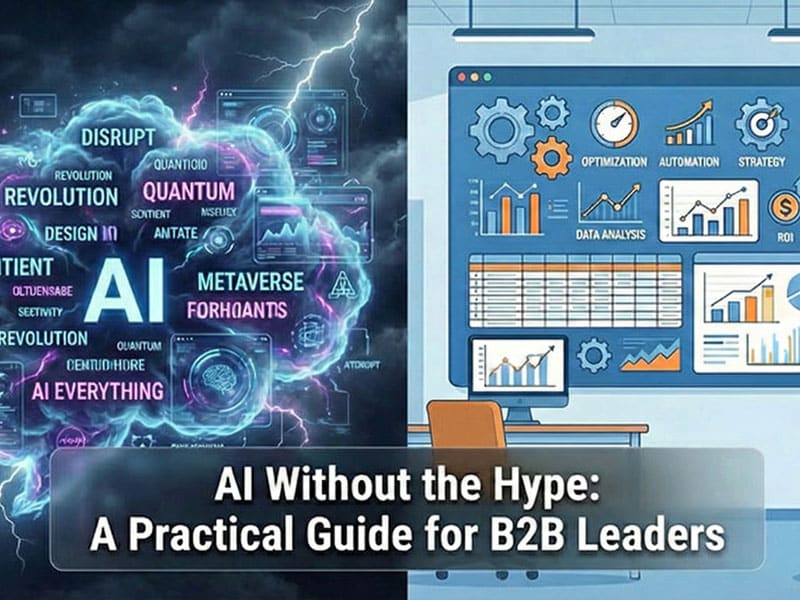
The AI recruiting tools market has exploded. Staffing firms now face a landscape of 200+ vendors claiming to automate everything from sourcing to onboarding. However, most of those claims are overstated. Some tools deliver real operational value for staffing firms. Others are built for corporate HR teams and struggle in the high-volume, speed-dependent, multi-client environment that defines staffing.
This guide evaluates the AI recruiting tools that matter most for staffing firms in 2026. For each tool, we cover what it actually does, where it fits in a staffing workflow and what its limitations are. We also address the question most tool reviews skip entirely: why tools alone are not enough and what the highest-performing staffing firms do differently.
If you run or lead a staffing firm evaluating AI investments, this is the no-hype assessment you need before writing any more purchase orders.
How we evaluated these tools
Every tool in this guide was evaluated against criteria that matter specifically to staffing firms, not generic HR departments:
- ATS/CRM integration depth: Does it integrate natively with Bullhorn, JobDiva, Avionte and other staffing-specific systems?
- Multi-client workflow support: Can it handle the multi-requisition, multi-client reality of staffing (not just single-company recruiting)?
- Speed to value: How quickly does it deliver measurable results after deployment?
- Recruiter adoption: Do recruiters actually use it daily, or does it become shelfware?
- Scalability: Does it work at 50 requisitions as well as it does at 500?
- Pricing transparency: Is the pricing model clear and sustainable for staffing margins?
No vendor paid for inclusion in this guide. These are independent assessments based on product capabilities, market positioning and staffing industry fit.
The best AI recruiting tools for staffing firms
1. Bullhorn Automation (formerly Herefish)
Category: Workflow automation and candidate engagement
Best for: Staffing firms already on Bullhorn ATS/CRM
Pricing: Tiered by firm size, typically $500-$2,000+/month
Bullhorn Automation is the most natural AI automation layer for the thousands of staffing firms running Bullhorn as their ATS. Specifically, it automates candidate engagement sequences, internal workflows and data hygiene tasks directly within the Bullhorn ecosystem. Key capabilities include automated candidate nurture campaigns, reactivation sequences for dormant database records, internal alerts and task creation based on triggers and data cleanup automation for duplicate records and stale data.
What works: Native Bullhorn integration is the standout advantage. Because automations run inside the system your recruiters already use, adoption improves dramatically. The candidate reactivation workflows are particularly valuable for staffing firms sitting on large databases of previously placed candidates. In fact, firms report 15-25% increases in redeployment rates after implementing automated reactivation sequences.
Limitations: The AI capabilities are more automation-focused than intelligence-focused. For example, it excels at “if this, then that” workflows but does not offer deep AI matching, predictive analytics or semantic search. As a result, firms looking for advanced AI-powered sourcing or matching will need additional tools. Also, setup and configuration require meaningful investment in mapping workflows before you see results.
2. Sense
Category: Candidate engagement, communication and talent intelligence
Best for: High-volume staffing with large contractor workforces
Pricing: Custom pricing, typically mid-market to enterprise
Sense is purpose-built for staffing firms. It addresses one of the industry’s biggest pain points: candidate engagement and communication at scale. The platform combines AI-powered messaging, chatbots, surveys and analytics to keep candidates engaged throughout the recruiting lifecycle and during active assignments.
What works: The conversational AI chatbot handles high-volume candidate screening, scheduling and FAQ responses effectively. As a result, staffing firms using Sense report 30-40% reductions in time-to-fill for high-volume roles. They also see significant improvements in candidate satisfaction scores. In addition, the contractor engagement features (assignment check-ins, NPS surveys, redeployment triggers) are uniquely valuable for staffing firms with large active contractor workforces. The platform also offers native integrations with Bullhorn, Avionté and other staffing ATS platforms.
Limitations: Sense is strongest in communication and engagement. It is not a sourcing tool or a deep matching platform. Therefore, firms expecting it to replace their sourcing workflow will be disappointed. The analytics capabilities, while improving, lag behind dedicated business intelligence tools. On top of that, pricing can be steep for smaller staffing firms.
3. Humanly
Category: Conversational AI for screening and scheduling
Best for: High-volume roles with straightforward qualification criteria
Pricing: Per-conversation or monthly subscription, accessible for mid-market firms
Humanly offers AI-powered conversational screening via chat and SMS. Candidates interact with an AI assistant that asks qualifying questions, verifies availability and interest, schedules interviews and captures data that flows into the ATS. The platform also provides interview intelligence features that analyze conversations for hiring insights.
What works: Humanly’s speed is its strongest advantage. Candidates can be screened within minutes of applying. This is a critical differentiator in competitive staffing verticals where the first firm to present a qualified candidate wins. Moreover, the conversational interface feels natural to candidates and avoids the cold, impersonal experience of form-based screening. Firms report 3-5x increases in screening throughput for high-volume roles. The tool also reduces bias by applying consistent screening criteria to every candidate.
Limitations: Conversational AI works best for roles with clear, binary qualification criteria (certifications, availability, location, years of experience). For roles requiring nuanced assessment of soft skills or cultural fit, the AI screening is a starting point, not a final answer. In addition, the platform’s value drops significantly for low-volume, specialized placements. In those cases, a recruiter phone screen is faster and more effective than setting up an AI flow.
4. Paradox (Olivia)
Category: Conversational AI assistant for recruiting
Best for: Enterprise staffing and RPO with very high application volumes
Pricing: Enterprise pricing, typically $50,000+/year
Paradox’s AI assistant, Olivia, is one of the most widely deployed conversational AI platforms in recruiting. It handles candidate screening, interview scheduling, offer management and onboarding communications through natural language conversations via text, web chat and WhatsApp.
What works: Olivia’s natural language processing is among the best in the category. Candidates often do not realize they are interacting with AI, which leads to higher engagement rates and better candidate experience scores. The scheduling automation alone saves significant recruiter time. For instance, firms report 80-90% reductions in scheduling-related administrative work. Paradox excels in very high-volume environments (500+ applications per week) where speed and consistency at scale are non-negotiable. It also offers strong enterprise integrations with most major ATS platforms.
Limitations: Pricing places Paradox out of reach for most small to mid-size staffing firms. The platform is optimized for high-volume use cases, so the ROI math does not work as well for firms handling fewer than 200 applications per week. Furthermore, implementation can take 8-12 weeks for full deployment, longer than many competitors. Customization for staffing-specific multi-client workflows also requires significant configuration effort.
5. hireEZ
Category: AI-powered sourcing and talent intelligence
Best for: Professional and technical staffing with hard-to-fill roles
Pricing: Starts around $169/user/month for professional plans
hireEZ (formerly Hiretual) is a sourcing platform that uses AI to search across 45+ open web platforms and databases to identify and engage candidates. It includes Boolean search building, AI-powered candidate ranking, contact information discovery and outreach automation.
What works: The breadth of sourcing is impressive. hireEZ aggregates candidate data from LinkedIn, GitHub, Stack Overflow, academic databases and dozens of other sources into a single search interface. As a result, AI-powered ranking surfaces the most relevant candidates first. This saves significant time compared to manual multi-platform sourcing. The contact discovery feature (email and phone) has 70-80% accuracy rates, which reduces the friction of candidate outreach. For staffing firms specializing in IT, engineering or other professional verticals, hireEZ can meaningfully expand the top of the recruiting funnel.
Limitations: hireEZ is a sourcing tool, not a full recruiting workflow solution. It does not replace your ATS, and the integration with staffing-specific platforms like Bullhorn is functional but not as deep as native solutions. In addition, the per-user pricing model can become expensive for larger recruiting teams. Data accuracy varies by source, so recruiters still need to verify candidate information before outreach. The outreach automation features are solid but less sophisticated than dedicated engagement platforms like Sense.
6. Fetcher
Category: AI-powered sourcing and outreach automation
Best for: Small to mid-size staffing firms needing sourcing support
Pricing: Starts around $149/user/month
Fetcher combines AI-powered candidate sourcing with automated outreach sequences. You define your ideal candidate profile, and Fetcher’s AI searches the web to build qualified candidate lists. Then the platform manages multi-touch email outreach campaigns with personalization and scheduling.
What works: Fetcher’s simplicity is its advantage. The platform is easier to set up and use than many competitors, which makes it accessible for staffing firms without dedicated technology teams. Moreover, the AI sourcing learns from recruiter feedback (approved and rejected candidates) and improves its targeting over time. The combined sourcing-plus-outreach workflow eliminates the gap between finding candidates and contacting them. This is where many staffing firms lose time. Firms report 50-70% reductions in time spent on initial sourcing activities.
Limitations: The AI sourcing quality is good but not best-in-class for highly specialized roles. Fetcher works best for roles with clear, well-defined criteria and a reasonably large candidate pool. In contrast, for niche technical or executive searches, dedicated search tools may produce better results. Also, ATS integrations exist but are not as deep as what Bullhorn-native tools offer. The outreach automation, while convenient, is less sophisticated than dedicated engagement platforms.
7. Textkernel
Category: AI parsing, matching and search
Best for: Staffing firms wanting to unlock their existing ATS database
Pricing: Custom pricing based on volume and modules
Textkernel specializes in the core AI infrastructure behind recruiting: resume parsing, semantic search, skills taxonomy and candidate-job matching. Rather than being a recruiter-facing application, Textkernel often powers the AI capabilities inside other platforms. It can also be deployed as a middleware layer that enhances an existing ATS.
What works: Textkernel’s parsing accuracy is among the best in the market, handling diverse resume formats across multiple languages with 90%+ accuracy. However, the semantic search capability is the real differentiator. It understands skills relationships, career progressions and role equivalencies in ways that keyword search cannot. For staffing firms sitting on databases of 100,000+ candidates, Textkernel can surface matches that were previously invisible. On top of that, the skills taxonomy is continuously updated, which keeps matching relevant as job markets evolve.
Limitations: Textkernel is infrastructure, not an application. Therefore, it requires integration work to deploy, and it does not provide a standalone recruiter interface. Staffing firms need technical resources (internal or external) to implement and maintain the integration. The value proposition is strongest for firms with large databases. Consequently, the ROI is harder to justify for smaller firms with fewer than 20,000 candidate records. Pricing is not transparent and requires a sales conversation.
8. SeekOut
Category: Talent intelligence and diversity sourcing
Best for: Professional staffing with diversity hiring requirements
Pricing: Starts around $199/user/month for professional plans
SeekOut is a talent intelligence platform that combines AI-powered sourcing with diversity analytics, skills-based search and talent pool insights. It is particularly strong in technical recruiting, with deep GitHub and patent data integration. It also includes robust diversity filters that help staffing firms meet client diversity requirements.
What works: The diversity sourcing capability is a genuine differentiator. Many staffing clients now include diversity requirements in their agreements, and SeekOut makes it possible to build diverse candidate pipelines systematically rather than relying on luck. In addition, the technical talent intelligence (GitHub analysis, patent data, publication records) provides depth that general sourcing tools miss. The AI-powered talent pool analytics also help recruiters and sales teams have data-informed conversations with clients about candidate availability and market conditions.
Limitations: SeekOut is strongest in professional and technical verticals. Staffing firms focused on light industrial, clerical or healthcare support roles will find less value in the platform’s technical intelligence features. Furthermore, the diversity features, while powerful, require careful implementation to comply with evolving regulations around AI-assisted hiring decisions. Like most sourcing tools, it supplements but does not replace the ATS workflow.
9. Phenom
Category: Talent experience platform with AI across the lifecycle
Best for: Large staffing firms and RPO providers
Pricing: Enterprise pricing, typically $100,000+/year for full platform
Phenom is a comprehensive talent experience platform that applies AI across the entire recruiting lifecycle: career site personalization, candidate matching, conversational AI, CRM automation, interview intelligence and internal mobility. It positions itself as an all-in-one AI recruiting platform rather than a point solution.
What works: The breadth of the platform means staffing firms can consolidate multiple point solutions into a single ecosystem. For example, the AI-powered career site personalization dynamically adjusts job recommendations based on candidate behavior. This improves application rates by 20-30%. The matching engine uses deep learning models trained on hundreds of millions of career data points, producing increasingly accurate candidate-job matches. For large staffing firms and RPO providers managing complex, multi-client operations, Phenom’s enterprise capabilities are difficult to match.
Limitations: Phenom’s pricing and complexity put it out of reach for most small and mid-size staffing firms. Full implementation can take 3-6 months, and the platform requires dedicated administrative resources to manage effectively. Moreover, while the breadth is impressive, the depth in any single category (sourcing, screening, engagement) may not match best-of-breed point solutions. The staffing-specific feature set has improved significantly but still reflects the platform’s corporate HR origins in some areas.
10. Eightfold AI
Category: Talent intelligence platform with deep-learning matching
Best for: Enterprise staffing and RPO with advanced AI maturity
Pricing: Enterprise pricing, typically $100,000+/year
Eightfold AI is one of the most technically sophisticated AI recruiting platforms on the market. Its Talent Intelligence Platform uses deep learning models trained on over a billion talent profiles to predict candidate-role fit, career trajectory and potential. The platform covers sourcing, matching, diversity, internal mobility and workforce planning.
What works: The matching accuracy is best-in-class. Eightfold’s models go beyond skills and experience to consider career trajectory patterns, learning velocity and potential. As a result, they produce matches that other platforms miss. The skills-based approach (rather than job-title-based) is forward-looking and aligns with how the best staffing firms are evolving their matching methodology. In addition, bias detection and mitigation tools are built into the platform rather than bolted on. This addresses a growing client requirement. Firms using Eightfold report 35-50% reductions in time-to-fill for professional roles.
Limitations: This is enterprise-grade technology with enterprise-grade pricing and complexity. Small and mid-size staffing firms will not find a viable entry point. The platform also requires significant data volume to deliver on its matching promise. That means the ROI is better for firms making thousands of placements annually. Implementation timelines of 3-6 months are typical. The technical sophistication is a double-edged sword: it delivers powerful results but requires more AI maturity from the organization deploying it.
AI recruiting tools comparison: staffing firm fit at a glance
The following table compares all ten tools across the criteria that matter most for staffing firms.
| Tool | Primary Function | Staffing ATS Integration | Best Firm Size | Speed to Value | Approx. Price Range |
|---|---|---|---|---|---|
| Bullhorn Automation | Workflow automation, engagement | Native (Bullhorn) | All sizes | 4-6 weeks | $500-$2,000+/mo |
| Sense | Candidate engagement, chatbot | Strong (Bullhorn, Avionté) | Mid-market to Enterprise | 4-8 weeks | Custom (mid-market+) |
| Humanly | Conversational screening | Good (API-based) | Small to Mid-market | 2-4 weeks | Per-conversation or subscription |
| Paradox (Olivia) | Conversational AI assistant | Strong (major ATS platforms) | Enterprise | 8-12 weeks | $50,000+/yr |
| hireEZ | AI sourcing, talent intelligence | Moderate (API-based) | Small to Mid-market | 1-2 weeks | $169+/user/mo |
| Fetcher | Sourcing + outreach automation | Moderate (API-based) | Small to Mid-market | 1-2 weeks | $149+/user/mo |
| Textkernel | Parsing, matching, semantic search | Integration required (API/middleware) | Mid-market to Enterprise | 6-12 weeks | Custom (volume-based) |
| SeekOut | Talent intelligence, diversity sourcing | Moderate (API-based) | Mid-market to Enterprise | 2-4 weeks | $199+/user/mo |
| Phenom | Full talent experience platform | Strong (enterprise integrations) | Enterprise | 3-6 months | $100,000+/yr |
| Eightfold AI | Deep-learning matching, talent intelligence | Strong (enterprise integrations) | Enterprise | 3-6 months | $100,000+/yr |
Which tools work best together?
No single AI recruiting tool covers the entire staffing workflow. The firms getting the most value are building integrated stacks where each tool handles a specific stage of the recruiting lifecycle. Here are the most effective combinations for different firm profiles:
For small to mid-size staffing firms (under 50 recruiters)
Recommended stack: Bullhorn Automation + Fetcher or hireEZ + Humanly
This combination covers workflow automation (Bullhorn Automation), AI-powered sourcing (Fetcher or hireEZ) and conversational screening (Humanly) at a price point that works for staffing margins. Total investment typically runs $1,000-$3,000/month depending on team size and volume. Most importantly, the three tools are complementary rather than overlapping. They all integrate with Bullhorn as the central system of record.
For mid-market staffing firms (50-200 recruiters)
Recommended stack: Bullhorn Automation + Sense + SeekOut or hireEZ + Textkernel
At this scale, the investment in deeper engagement (Sense), broader sourcing (SeekOut or hireEZ) and enhanced matching intelligence (Textkernel) pays for itself through measurable throughput and fill rate improvements. The key integration point is ensuring all tools feed data back into the ATS. That way, recruiters work from a single source of truth.
For enterprise staffing firms and RPO (200+ recruiters)
Recommended stack: Phenom or Eightfold AI + Paradox + Bullhorn Automation
Enterprise staffing operations benefit from platform-level solutions (Phenom or Eightfold) that consolidate AI capabilities. These combine well with specialized tools (Paradox for conversational AI, Bullhorn Automation for staffing-specific workflows) that address high-value use cases. At this scale, the technology investment is significant, but the operational leverage is too.
What are the biggest gaps in today’s AI recruiting tools?
Even the best tools on this list leave meaningful gaps. Staffing firms need to address these through strategy, process and governance rather than additional technology purchases.
Cross-tool data integration
Most AI recruiting tools create their own data silos. For example, sourcing tools have candidate data that does not flow to engagement tools. Similarly, screening insights do not feed matching algorithms. The result is a fragmented picture of each candidate and each search. To fix this, staffing firms need an integration strategy that ensures data flows between tools and back to the ATS as the system of record. This is a workflow architecture challenge, not a tool problem.
Staffing-specific workflow design
Many AI recruiting tools were built for corporate HR and later adapted for staffing. However, the multi-client, multi-requisition, speed-dependent nature of staffing creates workflow requirements that corporate HR tools were not designed for. Submitting candidates to multiple clients simultaneously, managing contractor redeployment pipelines and tracking margins by placement are staffing-specific workflows that most AI tools handle poorly or not at all.
Governance and compliance frameworks
As AI recruiting tools become more powerful, the governance requirements grow more complex. Bias auditing, data privacy compliance, candidate consent management and regulatory reporting are areas where most tools provide minimal support. Consequently, staffing firms need governance frameworks that sit above individual tools and ensure consistent compliance across the entire technology stack.
ROI measurement and optimization
Most AI recruiting tools report activity metrics (messages sent, candidates screened, interviews scheduled). However, they struggle to connect those activities to business outcomes (placements made, fill rates improved, revenue per recruiter increased). The gap between tool-level reporting and business-level ROI measurement is one that most staffing firms have not solved. Closing that gap requires a measurement framework that spans tools and connects recruiter activity to financial results.
Why tools alone are not enough
This is the section most AI recruiting tool reviews never write. Every tool on this list can deliver value. Yet none of them will deliver value on their own.
One pattern we see repeatedly across the staffing industry: a firm buys an AI tool, runs a demo-driven pilot, sees promising initial results, then watches adoption plateau and ROI stall within 3-6 months. The tool works. The implementation fails. The culprit is almost always the same set of gaps.
No integration strategy. Teams purchase tools independently, creating data silos and forcing recruiters to work across multiple disconnected platforms. As a result, the complexity increase offsets the efficiency gain.
No workflow redesign. AI tools get layered on top of existing broken processes. If your recruiting workflow is inconsistent before AI, it will be inconsistently automated after AI. In other words, tools amplify existing workflows, whether those workflows are good or bad.
No change management. Recruiters are told to use a new tool without being shown how it fits into their daily workflow, why it matters or how their performance will be measured differently. Consequently, adoption drops off within weeks.
No governance. Data quality issues, bias risks and compliance requirements are addressed reactively (or not at all) rather than proactively through a structured AI governance framework.
No executive ownership. AI is treated as an IT project or a recruiting manager’s side initiative rather than a strategic priority with dedicated leadership and cross-functional authority.
In our work with staffing firms, the ones pulling ahead with AI are not the ones with the most tools. They are the ones with a coherent strategy connecting their technology investments to business outcomes. They have a governance framework managing risk and compliance, workflow design that puts AI into the hands of recruiters in ways they actually use and leadership that owns AI outcomes at the executive level.
This is the strategic AI leadership layer that ChiefAI provides. Not another tool to add to the stack, but the strategic layer above the tools that ensures they work together, connect to business results and create compounding value over time. For staffing firms building their AI capabilities, the difference between scattered tool adoption and strategic AI deployment is the difference between adding cost and building competitive advantage.
Next steps
If you are evaluating AI recruiting tools for your staffing firm, here is how to move forward strategically rather than reactively:
Assess your starting point. Take the ChiefAI AI Readiness Assessment to evaluate your firm’s current AI maturity across five dimensions: leadership alignment, data infrastructure, workflow maturity, governance posture and team capability. This assessment determines which tools will actually deliver value in your current environment and which ones require foundational work first.
Audit your current technology stack. Before adding any new tools, map what you already have, what is being used, what is shelfware and where the integration gaps are. In our experience, many staffing firms already own AI capabilities they are not using. The workflow and training were simply never put in place.
Build an integrated AI roadmap. Rather than evaluating tools one at a time, develop an AI strategy roadmap that defines your target technology architecture, prioritizes use cases by ROI potential and sequences investments so each tool builds on the one before it. This prevents the patchwork problem that derails most staffing firm AI initiatives.
Get strategic AI leadership in place. Tools are the easy part. Strategy, integration, governance and change management are the hard parts. More importantly, they are the parts that determine whether your AI investment delivers returns. A fractional Chief AI Officer provides the executive-level AI leadership your firm needs without the overhead of a full-time hire.
The AI recruiting tools available to staffing firms in 2026 are genuinely powerful. However, the firms that win will not be the ones that buy the most tools. They will be the ones that deploy those tools strategically, measure their impact rigorously and evolve their approach continuously. Tools are the starting point. Strategy is the multiplier.
Ready to make AI work for your business?
Book a free strategy call. We will look at where you are today, identify your highest-ROI opportunities and give you a clear next step.